
History of indian cinema
The history of cinema in India extends back to the beginning of the film era. Following the screening of the Lumière and Robert Paul moving pictures in London (1896), commercial cinematography became a worldwide sensation and by mid-1896 both Lumière and Robert Paul films had been shown in Bombay.

Silent films (1890s–1920s)
In 1897, a film presentation by Professor Stevenson featured a stage show at Calcutta’s Star Theatre. With Stevenson’s encouragement and camera Hiralal Sen, an Indian photographer, made a film of scenes from that show, namely The Flower of Persia(1898).The Wrestlers (1899) by H. S. Bhatavdekar, showing a wrestling match at the Hanging Gardens in Bombay, was the first film to be shot by an Indian and the first Indian documentary film.
Talkies
(1930s–mid-1940s)
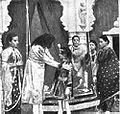
Ardeshir Irani released Alam Ara, the first Indian talkie, on 14 March 1931.Irani later produced the first south Indian talkie film Kalidas directed by H. M. Reddy released on 31 October 1931.Jumai Shasthi was the first Bengali talkie. Chittor V. Nagaiah, was one of the first multilingual film actor/singer/composer/producer/directors in India. He was known as India’s Paul Muni.
In 1932, the name “Tollywood” was coined for the Bengali film industry because Tollygunge rhymed with “Hollywood”. Tollygunge was then the centre of the Indian film industry. Bombay later overtook Tollygunge as the industry’s center, spawning “Bollywood” and many other Hollywood-inspired names.
In 1933, East India Film Company produced its first Telugu film, Savitri. Based on a stage play by Mylavaram Bala Bharathi Samajam, the film was directed by C.pulliah with stage actors Vemuri Gaggiah and Dasari Ramathilakam. The film received an honorary diploma at the 2nd Venice International Film Festival.
No. of screens6,780 single screens (2017)
2,100 multiplex screens (2016) • Per capita9 per million (2015).Produced feature films (2018).Total1,813Number of admissions (2016)Total20,000,000[further explanation needed] • Per capita1.69National films1,713,600,000Gross box office (2017).Total₹158.9 billion($2.44 billion)National films$2.1 billion (2015)
The cinema of India consists of films produced in the nation of India. Cinema is immensely popular in India, with as many as 2,000 films produced in various languagesevery year. Indian cinema produces more films watched by more people than any other country; in 2011, over 3.5 billion tickets were sold across India, 900,000 (0.03%) more than Hollywood. Mumbai, Hyderabad, Kolkata, Chennai, Kochi and Bangalore are the major centres of film production in India.
Classic Bollywood
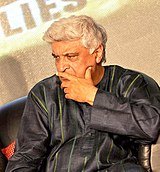

The screenwriting duo Salim-Javed, consisting of Salim Khan (l) and Javed Akhtar (r), revitalised Indian cinema in the 1970s, and are considered Bollywood’s greatest screenwriters.
By the early 1970s, Hindi cinema was experiencing thematic stagnation,dominated by musical romance films. The arrival of screenwriter duo Salim-Javed, consisting of Salim Khan and Javed Akhtar, revitalised the industry. They established the genre of gritty, violent, Bombay underworld crime films, with films such as Zanjeer (1973) and Deewaar(1975).They reinterpreted the rural themes of Mother India and Gunga Jumna in an urban context reflecting 1970s India,channelling the growing discontent and disillusionment among the masses,unprecedented growth of slums and urban poverty, corruption and crime, as well as anti-establishment themes. This resulted in their creation of the “angry young man”, personified by Amitabh Bachchan,who reinterpreted Kumar’s performance in Gunga Jumna, and gave a voice to the urban poor.
New Bollywood



In the late 1980s, Hindi cinema experienced another period of stagnation, with a decline in box office turnout, due to increasing violence, decline in musical melodic quality, and rise in video piracy, leading to middle-class family audiences abandoning theatres. The turning point came with Yash Chopra’s musical romance Chandni (1989), starring Sridevi. It was instrumental in ending the era of violent action films in Indian Cinema and rejuvenating the romantic musical genre.It also set a new template for Bollywood musical romance films that defined Hindi cinema in the coming years. Commercial Hindi cinema grew in the late 80s and 1990s, with the release of Mr. India (1987), Qayamat Se Qayamat Tak (1988), Chaalbaaz (1989), Maine Pyar Kiya (1989), Lamhe (1991), Saajan(1991), Khuda Gawah (1992), Khalnayak (1993), Darr (1993),Hum Aapke Hain Koun..! (1994), Dilwale Dulhaniya Le Jayenge (1995), Dil To Pagal Hai (1997), Pyar Kiya Toh Darna Kya (1998) and Kuch Kuch Hota Hai (1998). Cult classic Bandit Queen (1994, Shekhar Kapur) received international recognition and controversy.
Bahubali(pride of indian cinema)
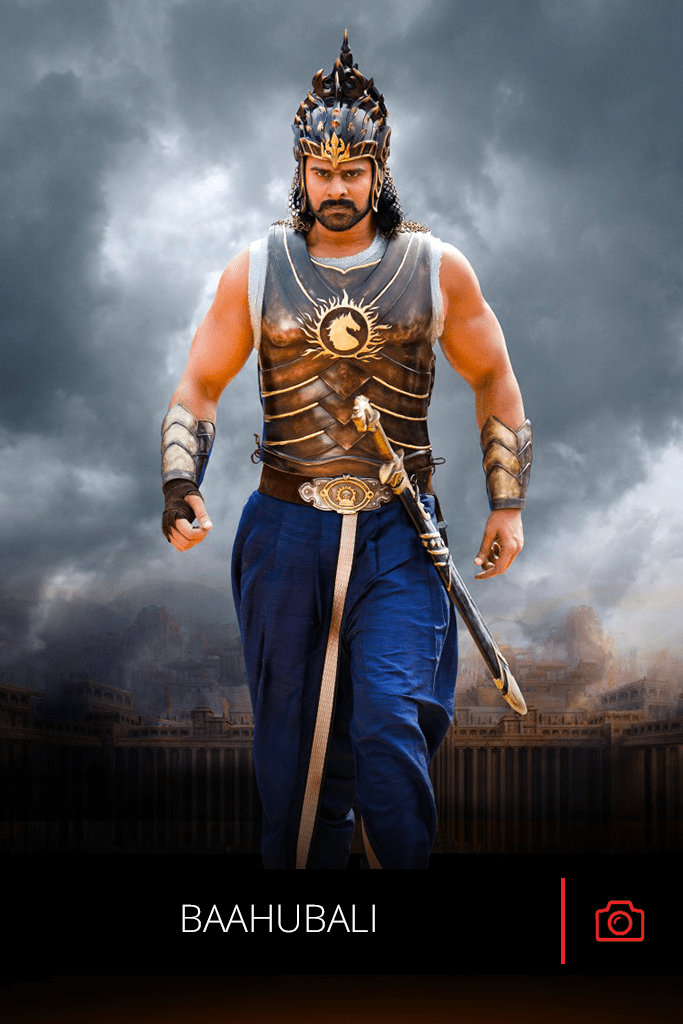
Baahubali movie has divided into two parts
1.Bahubali-The beginning
2.Bahubali-The conclusion
Baahubali: The Beginning

Baahubali: The Beginning is a 2015 Indian epicaction film directed by S. S. Rajamouli. The film was produced by Shobu Yarlagadda and Prasad Devineni and was shot in both Teluguand Tamil. This film was also dubbed into Malayalam and Hindi. The film stars Prabhas, Rana Daggubati, Anushka Shetty, and Tamannaah in the lead roles, with Ramya Krishna, Sathyaraj, and Nassar in supporting roles. The first of two cinematic parts, the film follows Shivudu, an adventurous young man who helps his love Avanthika rescue Devasena, the former queen of Mahishmatiwho is now a prisoner under the tyrannical rule of king Bhallaladeva. The story concludes in Baahubali 2: The Conclusion.Baahubali: The BeginningTheatrical release posterDirected byS. S. RajamouliProduced by
Written byK. V. Vijayendra PrasadScreenplay by
- K. V. Vijayendra Prasad
- S. S. Rajamouli
Story byK. V. Vijayendra PrasadStarring
Music byM. M. KeeravaniCinematographyK. K. Senthil KumarEdited byKotagiri Venkateswara RaoProduction
companyArka Media WorksDistributed by
- Telugu:
- Arka Media Works
- Hindi:
- Dharma Productions
- Tamil:
- Studio Green
- Sri Thenandal Films
- UV Creations
- Malayalam:
- Global United Media
Release date
- 10 July 2015
Running time
- 158 minutes (Telugu)
- 159 minutes(Tamil)
CountryIndiaLanguage
- Telugu
- Tamil
Budget₹180 croreBox office₹ 650 crores
The film was conceived by Rajamouli’s father K. V. Vijayendra Prasad, who randomly told him a story about Sivagami, a woman who carries a baby in her hand while crossing a river, and a few years later about Kattappa, which intrigued Rajamouli. His fascination with mythology and the tales of the Amar Chitra Katha comics further fuelled his interest in the story. However, it took the writers three months to complete the final draft. The soundtrack and background score were composed by M. M. Keeravani while the cinematography, production design, and VFX were handled by K. K. Senthil Kumar, Sabu Cyriland V. Srinivas Mohan respectively.
The film was made on a budget of ₹180 crore(US$25 million), making it the most expensive Indian film at its time of release. The film opened worldwide on 10 July 2015, garnering critical acclaim and record-breaking box office success. With a worldwide box office gross of ₹650 crore (US$91 million), it became the highest-grossing film in India, third highest-grossing Indian film worldwide, and highest-grossing South Indian film, at the time of its release. Its Hindi dubbed version also broke several records by becoming the highest-grossing dubbed film in India. Both budget and box office records have since been surpassed by Baahubali 2: The Conclusion, the second highest grossing Indian film of all time.
It received several accolades. It won the National Film Award for Best Special Effectsand Best Feature Film, becoming the first Telugu film to win the award. At the 63rd Filmfare Awards South, the Telugu version won five awards from ten nominations, including Best Film, Best Director for Rajamouli and Best Supporting Actress for Ramya Krishna respectively. Baahubali: The Beginning became the first Indian film to be nominated for Saturn Awards, receiving five nominations at the 42nd ceremony, including Best Fantasy Film and Best Supporting Actress.
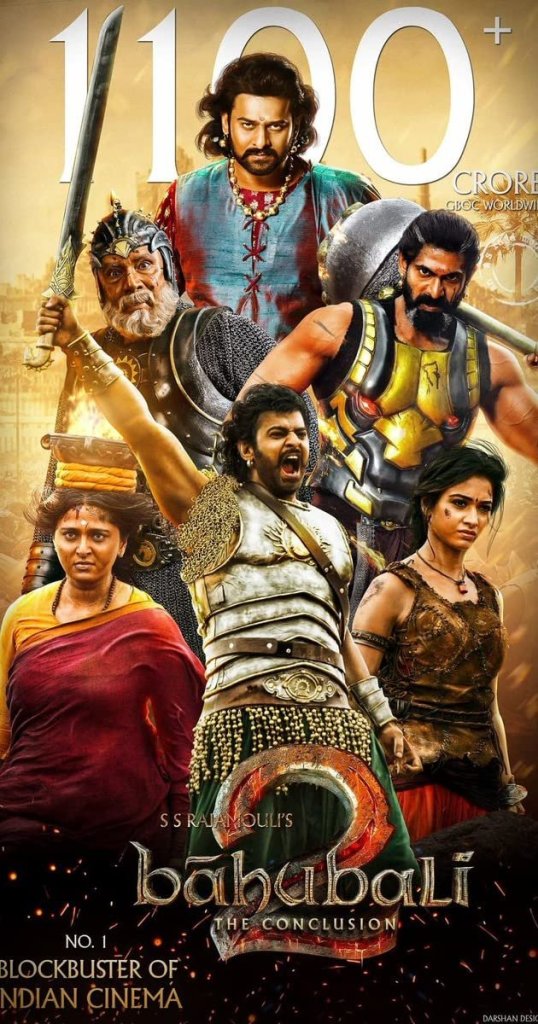
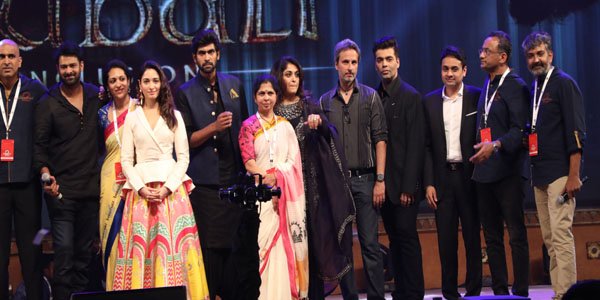
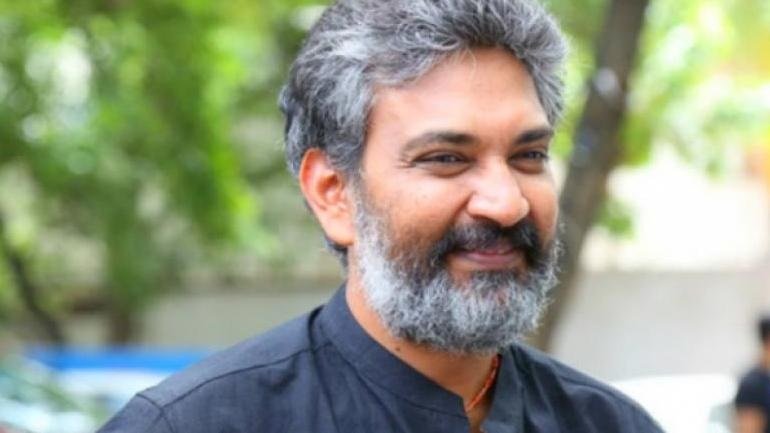
Bahubali-2 collected more than its previous part of whooping 1100+CR.This film had no boundaries as it is loved by everyone around the world.The director Rajamouli and his team had changed the level of indian cinema by making an international film and which made the india cinema proud.
 Site Title